Friday, November 4, 2011

The Great Shopping Tamasha


Shopping to the hilt!

Among my relations, I have a Chitappa who is affectionately ‘called in family circles “the weekend offer Chitappa” because he reserves all his purchases for the week-end when supermarkets and big names in retail vie in offering freebies and discounts. He is upto date on schemes of various super markets to the extent that even if one had to step out to buy a packet of rice, he would start off by saying, “why are you going now? “You should go at 3.00 PM on a Saturday to the supermarket back office where you will get a kilo of Basmati rice for as little as Rs. 50”. With marketing guys in a perpetual race to grab heftier market shares,bargains and offers deals and combo -offers from super, hypermarkets are bombarding us all the time and for folks like Uncle, it’s double whammy all the time. When Uncle visited Delhi, he loved nothing better than to explore the by-lanes of Ajmal Khan Road, in search of the best bargain in the Delhi-specific unorganized electrical/ electronic items market. Nothing was healthier, heartening to the soul than a cheery, “Sardarji, Kee Gaal”’ get down to business and wind up the bargain with a satisfactory hammering down of the price of a mixer from its quoted price of 1000 bucks to 500 bucks.
    

It was in the presence of this uncle that  my mom decided to sell old Newspapers to the street vendor. No sooner did she mention her intentions, than Uncle  said, “Forget this chap. Let’s go to Hyper mart, where you can sell not only old newspapers  but also old discarded household items of every conceivable kind ranging from clothing to kitchen utensils,from decades-old toasters and irons to downgraded electronic waste of recent origin for better value”. So that is how, Mom loaded all her sundry items into her Maruti van and headed for Hyper -mart  with uncle beside her.  The Sales girl patiently sorted mum’s things, valued them and handed over a packet of coupons to Mom. “What’s this?” said a surprised Mom. “Ma’am, this is our latest offer,” beamed the Sales girl. “Earlier, you could exchange your old,even damaged household for  articles of the same type from Megamart at a lower price. Now, we have gone a step further to give our customers a better deal. We issue coupons which they can exchange to buy articles of their choice at the discount rate mentioned in the coupon. I have issued coupons of a face value of Rs.5000/- which you can use  up entirely if you make purchases  with us. Imagine,you will be getting goods worth  Rs.9000/- by just spending Rs. 5000/- VALUE SHOPPING FOR  OUR VALUABLE CUSTOMERS  is our motto. Mom’s head was in a whirl. This was indeed a Catch 22 situation-instead of getting hard bucks for her old things, here she was saddled with discount coupons  and she had to think up ways and means to  utilize them. How on earth was she going to figure out what did she need  to buy ? Besides the offer was time-bound. “ Don’t worry”,  said Uncle. “ We can use up the coupons in no time. A household needs so many things- from bread to bedsheets,tooth-paste to touristers- an entire gamut of consumables and consumer products. Also you can pass on these coupons to your friends and relatives if you can’t use them within the OFFER period.It’s the  Steal of a Lifetime, whichever way, you look at it!” and he rubbed his hands in glee.
  
How Mom worked her way through the coupons is another story. At the end of their last visit to Megamart, Uncle wandered off to the marketing office, after excusing himself. ““Now what?” wondered a weary Mom. After a long wait, Uncle returned all in smiles. “All those who have used up their Coupons entirely get freebies like Free Mobile Talktime. I went over to collect freebies coming our way”, said Uncle on his way to the exit.
   
Just then a Mall executive waylaid them.  “ Excuse me”, he said.  I think you are Coupon Holders. Today, being the last day for using up coupons, Megamart celebrates tomorrow as  Grand Coupon Completion Day herein  the store will honour all those  customers who successfully used up their coupons. Additionally, there is also a Super Duper  Loyalty Award to these loyal customers-  tomorrow we will reissue fresh coupon to them for free. They don’t have to bring their old things. Don’t miss this Opportunity to shop to your heart’s content”, and he went on and on. Uncle listened, as if spell-bound. “Tomorrow, we should make it here’, he said turning in  Mom’s direction.
     Mom was not there! Anybody listening?

The Facebook Of life

First Daffodil
Daffodils, the flowers symbolising friendship, are one of the most popular flowers exclusively due to their unmatched beauty


An email had arrived  from Geetha  saying that she was coming to Bangalore and wanted to visit me. My excitement in anticipation of her visit knew no bounds  and my mind, at once  swirled with mixed emotions.  Geetha and I had been together in school in the early seventies in a convent in the coal city of Dhanbad, where every girl knew each other very intimately because we were such a small class .  But thirty- five years down the road, how would we react to each other? Would we warm up to each other or would be stiff and formal with each other? As schoolgirls, our affection had been unrestrained and unreserved; now life’s turns and twists had mellowed us. Yet, there was so much to talk about, so much to catch up with...... one meeting after three decades would not be enough!
    Geetha came and in an instant, adult ice thawed to school-girlish warmth as we hugged each other.  Time flew as we talked about this and that, about dear friends in distant places, about pranks played and prizes won, about favourite teachers, about our work and about our families. We held hands and walked down Memory lane;   sharing memories of a past that now lives in yellowing class photos. Geetha left with a promise to look me up whenever she visited Bangalore. We exchanged tokens but the  greatest gift was the nostalgic journey that we had jointly undertaken into a golden past. We had built our lives apart but the spirit of the Old Boys still egged us on. As Geetha remarked, “ Today we have met at a time when our children are taller than you and me ever were in school; yet our bonds are eternal and forever”.
    True, Age may have placed a wrinkle on our brow but  we are still young in spirit and soul. School-friends may live continents apart but they will always live in each other’s hearts.  Every generation posts scraps and souvenirs of its school-life  in Life’s Facebook, which cannot be  electronically deleted  or trashed.
           
For oft, when on my couch I lie
In vacant or in pensive mood,

They flash upon that inward eye

Which is the bliss of solitude;

And then my heart with pleasure fills,

And dances with the daffodils.

Monday, March 7, 2011

Sivakami's World


Sivakami’s world comes crashing around her when at eighteen, she  becomes a widow with two young children to bring up in the backdrop of nineteenth century south India. How this illiterate, young woman, belonging to an orthodox Brahmin family and bound by the social traditions of a rigid, unyielding society brings up  not only her children but also grand children in a remote, sleepy village near Tiruchi, thereby becoming a solid family bedrock  forms the seed of Padma Viswanathan’s novel,”The Toss of a Lemon”. The story of Sivakami could be the story of anyone of us.  This dimunitive,plain looking illiterate woman  who cannot walk in public gaze in daylight; who is required by social norms to shave her head and cast away all symbols of feminineness single-handedly raises her two children to adulthood and marriage.     
    At the time of the story, eight year old Sivakami is married to a village astrologer,  who has the singular misfortune of knowing beforehand  through a star forecast that  he  is destined to die in the third year after a son is born. As fate would have it, a son is born to the couple, and the occasion instead of being joyous becomes one of foreboding doom as Sivakami’s husband starts preparing in a matter-of-fact manner for his impending death. He has lands,in which his tenants grow paddy and other crops- revenue and other dues have to be collected, agricultural produce has to be stored and sold. All this is a man’s work- how can Sivakami manage all this, that too without going out to the fields?  So Hanumarathnam, her husband appoints a  supervisor who will take over all this work after his death! But Sivakami cannot afford to live in a state of practical ignorance. So, Sivakami, who hardly went to school starts learning from Hanumarathnam, how to maintain household as well as agricultural accounts, in order to equip herself for any eventuality!
    The prediction of Hanumarathnam’s death comes true and Sivakami is hurled into widowhood with all its macabre trappings. So what has life got in store for  a child widow who till yesterday was wearing delicate trinkets and playing pallankuzhi but now has to bring up two infants in a world where she cannot remarry but must live an austere life devoid of any comfort! Brahmin society required that a widow should merely subsist on minimum and not be a burden. Sivakami however carries her heavy burden on her light shoulders and accepts her new state with stoic pragmatism. Perhaps her simple, abiding faith in the household deity of Ramar, to which she makes a daily offering of fruits and milk stands by her in her hour of need. For whatever be her mental or physical state, throughout her life, Sivakam performs pooja to the Ramar, without blame, without expectation. Women those days learnt very early to cope with their lot whatever that may have been in store; some may have had a better life but destiny was never in their hands!      Women like Sivakami were tough and resilent; they managed to grab little time from the daily grind to indulge in “ladylike” pursuits like embroidery and weaving floral garlands. We also get glimpses of frugal and disciplined house-keeping of those days.-children sit around their grandmother Sivakami, after their return from school and she gives each child a nutrition laddoo which would last them till dinner-time; there were no fancy tiffins to suit varied tastes and tongues. Such disciplined upbringing stood the kids in good stead-they learnt the value of wholesome simple food without fancy or frill. Extended families were the norm, not the exception; especially in matters of extending hospitality, people’s hearts were larger than their hearths. Men were socially superior because they had to fulfil the role of Protector of the womenfolk; they demanded unquestioning and implicit obedience and we find the women accepted this situation without murmur or complaint.
    Sivakami does a fine balancing act of fulfilling her parental responsibilities without even stepping out of the house and without breaking social tradition.  She not only rears her children to adulthood but also her grand children, the children born to her daughter. Once again Fate plays a cruel game with Sivakami, when herdaughter dies during child-birth, and the role play of sivakami’s life is enacted out. Sivakami sees through six grand-daughters and three grand-sons through childhood, adolescence, marriage and even childbirths of  great grand -children. This small-made lady never has the time to think of herself or why fate has ordained her to live thus, there is so much of household work to be attended to- Sivakami makes all preparations herself for the various family functions, cooks are hired only for weddings etc. even while running the household and managing even the expenses of the grand-children because the son-in-law is a good for nothing.
    Frugality, kind-heartedness, patience, attentive care while performing household work were some of the values that Sivakami practised every single day of her life. Into this rivetting tale of Sivakami’s family is woven the socio-economic changes of British India and already the clamour of freedom is heard in the distance. Sivakami’s own son dubs her an “ignorant, superstitious” widow but conditioned to live as she does, Sivakami is unable to reinvent herself. This leads to a strained almost hostile relationship with her son; yet stout of heart and mind that Sivakami is, she moves on.
    Sivakami’s world and the times that she lived in may be bygone and forgotten. Yet the value system that Sivakami was, will always sustain us against the odds thrown up by life.


Wednesday, February 9, 2011

When I became Jane Austen


Do we have the time to do the things that we want to do? Pursue a hobby of our interest,let the creative juices flow, do a sudoku......the list of stress busters is endless. We are always being told of the things that we ought to do to keep us going, to keep our mental clock ticking in order to lead a happier and healthier life.
For each of us, the mode of relaxation is different. Jamshedji Tata,  the iconic businessman flew planes; that was his passion which helped him to relax but for ordinary home-makers like  you and me, it could be sketching, painting, stitching or even writing. Writing, they say expands the mental horizons, the emotional make-up of a person and above all gives one an intellectual high. But any hobby can be stimulating only if it is nurtured and sustained, for which a high level of commitment is necessary. One has to take time out of the daily grind to sustain a hobby. Herein lies the problem.The whirlpool of endless household chores can suck many a budding talent in a homemaker into its relentless currents. In India especially, the social demands on a woman within and without the family set-up are quite taxing-it’s a tight-rope walk between home-maker and careerist. How many times have I heard the familiar wail, “I  used to play the veena quite well. But after marriage and children, it all went up in smoke”.
Many  have however, managed to  successfully span the wide chasm between the daily grind and hobby; between  what needs to be done to keep the wheel of life’s routine rotating and what we would like to do for emotional gratification. Here again the family’s concurrence(read as co-operation from husband) is absolutely essential.
I have been fortunate in that my husband has been supportive of my interest in writing. “You should write more and consistently” is his refrain, to which my perennial lament is “I wish I had the time and energy to do that”. To which, he looked at me pityingly and said, “Nobody gets time, you have to make time”.  After initially bristling at his remark, I started thinking seriously about what he had said.  Maybe there was something to what he had said. All the scary health columns that I had been reading like,  “Do something creative in order to stimulate brain activity.Research findings have proved that brain exercises like doing sudoku,learning a new activity, writing or even reading poetry etc. will ward off  early onset of senility, Alzheimers’........... you get the drift, I suppose.
So how was I going to save my “grey cells”  at least in the interests of my own health? “ You spend too much time in the kitchen, it drains you. You should get a cook ”, declared a friend. “Easier said than done,”I thought. Could I relinquish with a single stroke, “ my time- honoured, careful and considerate duties in the kitchen to the hands of an outsider”. I was torn between familial bonds and my own creative needs. Then one day, a friend who runs a paper called up to ask why I had not written a piece for her for so long, accusing me of burying my interest and not writing enough. Find the time to write”, she urged. The demons of senility and Alzeihmer floated before my inward eye  and I realized that something had to be done about this and that too rather urgently.
I managed to find a  kitchen help with great difficulty. I would not call her by the lofty title  of “cook", because she was sent with references of “an amicable assistant always willing to  learn”. Not a great resource  but I hoped to train her to take over my kitchen so that I could focus on more “ fulfilling ” activities.  After  instructing her about the day’s menu, I  made  an effort to collect together my creative thoughts. “ Now for some crisp writing ”, I would think and just as I  manage to collect together my thoughts,  Mrs. AA (Amicable Assistant, if you please) put her head round the door and asked, “ Amma, you did not say whether I should use dal or coconut in the Sambhar!” I would sort out the issue to return to my literary pursuits only to be interrupted by another silly query from Mrs. AA, “ Amma,  should I use pepper or chillies in the rasam”.  
Then one day, my husband complained that the Sambhar tasted funny.” “ Oh no”, he hastened to add.” Don’t start interfering in her work, for heaven’s sake. Anyway, you take too long in the kitchen over a sambhar and rice.We got to use her, after getting her with so much difficulty.In finance, we call it captilization of an asset”. With that, he valiantly swallowed the watery sambhar and leathery chappathis. 
So that was that. Mrs. AA’s ill-health continued indefinitely. I soon realized that she had no intention of coming back. Nor did I have any regrets. My literary visions had  curled up like a wisp of smoke to vanish into thin air, much like Mrs.AA. In the process, I had landed on Terra firma, with a BIG BANG. My literary dreams could wait for the time being but the family could not. I belonged to a generation that had dreams and the courage to pursue them but what about all the women before me who,


 only knew to slog and slave,
grind and grate ,roast and bast over a hot kitchen fire,
wiping away beads of perspiration in a sweltering, airless kitchen, hot and humid to churn out mouthwatering delicacies
all devoured in no time.
The kitchen was their home, 
the family their world; they knew none else.
their love boundless, their service endless.
The fragrance of  burnt incense 
hung over the family unit,
cosy and content, happy and healthy.
Hail O woman of Yester Year 
Whose dreams were not bigger than family and society.

Sunday, December 12, 2010

The Tree that gave


Tree of Plenty


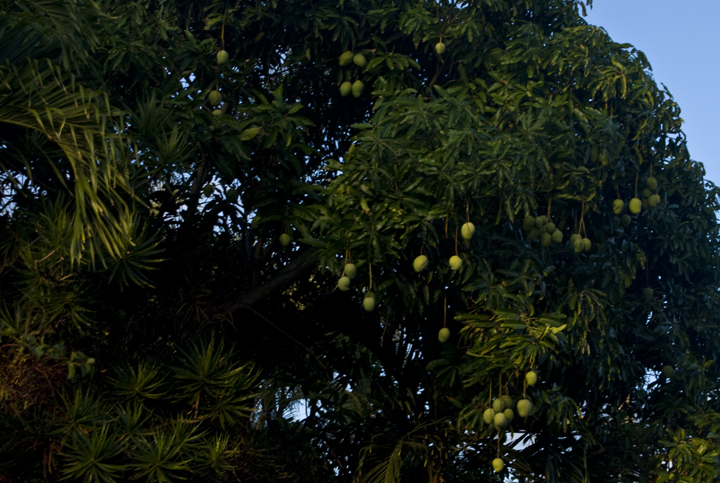
Its origin, nobody knew.A stray seed scattered by a stray crow fell on a house property. Unlike many scattered seeds which  for various reasons never make it, this one seed however took root. It grew  first into a plant and then a beautiful, bountiful mango tree, lush and green, giving luscious, delicious  fruit. In peak season, its branches were weighed down with golden mangoes. Tall and majestic, bringing forth endlessly and abundantly, year after year the choicest fruit, it was indeed the owner’s Pride and Neighbour’s Envy. “ Do you know?” the lady of the house would start while talking  to visitors and guests and then go on  to recount the story of how a stray seed had grown into a full-fledged Alphonso Mango tree. Everybody would then troop out to admire the mango tree, gape at its fruit- laden branches while the tree stood by graciously and loftily, basking in all the admiration. The tree needed no special care and yet gave abundant fruit. Year after  year, the mango plucker came with his stick and basket and brutally knocked down the exotic fruit, which was then ripened under the watchful eye of the lady of the house and packed in crates to be sent to near and dear ones in distant places. Did the mango tree feel sad? Did it  feel any pain? Nobody knew. Nobody cared. Everybody was interested only in its fruit which it gave  endlessly and countless year after year. The only truth which the tree knew was to bear fruit and give  to all those who asked and all those who sought. Then the son of the house married and the lady of the house brought her brand new daughter-in -law to the tree and proudly said, “ This mango tree is the pride and glory of our family”. The mango tree, waited by for some acknowledgement of its prowess but none came. Maybe the city-bred daughter-in-law  did not care about the mango tree or was too pre-occupied with other concerns. She merely looked at the tree and moved on.”Never mind”, said the tree to itself.” She has just come; she will learn to like me”.
Years passed and the tree was now almost forty years old.Other than watering,it was not given anyspecial care. Old it may have grown  but its fruit was abundant still.  As with any city, things including a regular gardener had become pretty expensive and the odd “gardener” who came along hardly bothered about the tree. But the tree stoically bore fruit, eaten and relished by the family. In the peak mango season,  the tangy smell of raw mango penetrated nostrils, bringing in its wake memories of spicy, succulent pickles and chutneys.    Human beings become old and the comely bride of yester-years  was now a matronly homemaker, with creased brows and furrowed forehead. But the tree never tired of bearing fruit  andwas forever green and always fresh. Then a strange thing happened. The bride of old, as if in a sudden burst of enlightenment, wrapped her arms around the tree and cried, “ Oh great tree, how green and fresh and generous are you. Oh! how I wish I had realised your importance when I was younger, clambered on your branches and plucked your fruit. But now, my arthiritis prevents me from enjoying nature’s simple pleasures”.
Tears streamed down the tree’s cheeks.Her bountiness had at last been acknowledged, at last she had won a place in the bride’s heart. her sacrifice had not been in vain.
Let us turn a new leaf in our lives-like the tree,let us give without asking and without end.Let us return manifold both to nature and society. Like the tree, we have to recharge both society and ecology to serve posterity.